Industrial robots
Industrial robots for UK manufacturing
Industrial robots are programmable machines, usually robot arms, that weld, paint, assemble, pick, palletise and tend machines in factories. For UK manufacturers, robotic automation works best when the robot is chosen for the task. Forge Robotics matches the right industrial robot to your task across manufacturers, supplies it where that fits, and plans how the cell connects to your systems.
Forge Anvil is being developed to connect robot cells to a site’s own systems; connections are scoped site by site. How our integration software is designed to work
By Forge Robotics · Last updated:
The basics
What counts as an industrial robot?
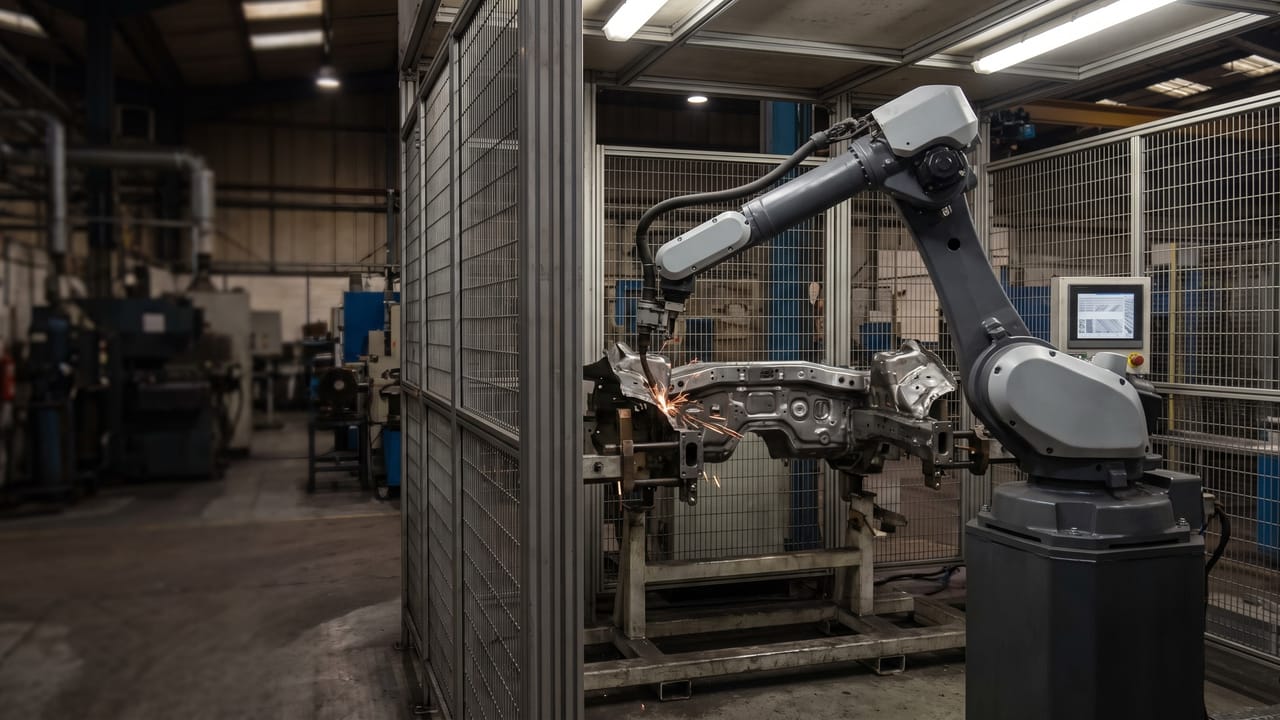
An industrial robot is an automatically controlled, reprogrammable machine with three or more programmable axes, used for automation in an industrial setting. In practice it is usually a robot arm bolted to the floor or a rail, working inside a guarded cell on a repeatable task such as welding, handling or assembly.
That definition comes from ISO 8373, the robotics vocabulary standard, and is the one the International Federation of Robotics uses. Reprogrammable means the robot’s movements can be changed in software without rebuilding it; an axis is one direction of motion or rotation. The robot on its own is only part of the machine: the tool on the end of the arm, the guarding and the controls turn it into a working cell.
Industrial robots differ from service robots, such as quadrupeds or mobile inspection robots, which move around sites and work near the public. On a factory floor, industrial robot automation is still built mostly around fixed arms.
Robot types
What are the types of industrial robots?
There are five main types of industrial robots: articulated arms, SCARA robots, delta or parallel robots, Cartesian or gantry robots, and collaborative robots. Each moves differently, which suits it to different jobs, from heavy welding and palletising to very fast picking of light items. The task usually points clearly to one or two types.
Articulated robots are the most familiar and the most flexible. SCARA (Selective Compliance Assembly Robot Arm) robots are fast and compact for small-part assembly. Delta robots hang overhead and pick light products at speed. Cartesian robots run on straight axes over a large area.

| Type | How it moves | Typical jobs | Strengths |
|---|---|---|---|
| Articulated | A jointed arm, usually six axes, like a human arm | Welding, painting, machine tending, palletising, assembly | Reach, flexibility, wide payload range |
| SCARA | Four axes; moves fast in a flat plane, rigid vertically | Small-part assembly, screwdriving, pick and place | Speed and precision on a compact footprint |
| Delta (parallel) | Three or more light arms joined at one head, mounted overhead | High-speed picking and packing, food and pharma | Very fast with light items |
| Cartesian (gantry) | Straight-line X, Y and Z axes on a frame | Loading machines, large-area handling, dispensing | Large work areas, simple, scalable |
| Collaborative (cobot) | Usually six axes, with force sensing for shared space | Machine tending, welding, packing near people | Small footprint, quick to re-task |
Collaborative robots are covered in detail on our cobots page, including when a cobot suits a job better than a guarded industrial robot.
Use cases
Where does robotic automation fit in UK manufacturing?
Robotic automation fits best where work is repetitive, runs at a steady rate and needs consistent quality: welding, painting, assembly, high-speed pick and place, packing, palletising and machine tending. Manufacturing robots also take people away from heavy, hot or hazardous tasks. The strongest first projects have predictable parts, clear volumes and a measurable cycle time.
Welding and joining
Spot and arc welding, often the first job automated on fabrication and body lines.
Painting and coating
Even, repeatable finishes in spray booths people should not have to work in.
Assembly
Fitting, fastening and inserting parts where position and torque must be consistent.
Pick and place, packing
High-speed handling of small parts and products between conveyors, trays and cartons.
Palletising
Building pallet loads of cases or sacks at the end of a line, shift after shift.
Machine tending
Loading and unloading CNC machines, presses and moulding machines.
How to spot a good first application
- The task is repetitive and the parts arrive in a consistent position, or can be made to.
- The volume, or the number of shifts, keeps the robot busy most of the time.
- The job is heavy, hot, dirty or hard to staff, so people gain from moving off it.
- The cycle time and quality you need are clear and can be measured before and after.
- There is floor space for a guarded cell and access for maintenance.
Sector detail sits on our manufacturing and industrial and automotive and engineering pages.
Who does what
Industrial robot suppliers vs integrators: who does what?
Industrial robot suppliers sell the robot arm and its controller. An integrator designs and builds the cell around it: end-of-arm tooling, guarding, safety controls, the PLC and links to factory systems, then commissions it. A robot on its own is not a working machine, so most projects need both roles, sometimes from one company.
Robot supplier
Sells the robot arm and its controller, often with software options and spares. The arm on its own is not a working machine.
Robot integrator
Designs and builds the cell: robot, tooling, guarding, controls and PLC, then commissions it and supports the safety case.
Forge Robotics
Advisory and integration: matches the robot to the task across manufacturers, supplies it where that fits, and plans the connection to site systems.
End-of-arm tooling is the gripper, torch, spray gun or tool fitted to the robot’s wrist; a PLC (programmable logic controller) is the industrial computer that runs the line around the robot. Well-known industrial robot makers include the following, listed alphabetically, not ranked:
- ABBarticulated, SCARA, delta and collaborative arms
- Epsonknown for SCARA robots
- FANUCarticulated, SCARA, delta and collaborative arms
- Kawasaki Roboticsarticulated arms, including palletising
- KUKAarticulated arms and collaborative models
- Stäubliarticulated and SCARA arms
- YaskawaMotoman articulated arms, strong in welding
Manufacturers looking for a UK route to market can read how we work with manufacturers.
Safety
What safety rules apply to manufacturing robots in the UK?
Manufacturing robots in the UK fall under machinery and work-equipment law. A finished robot cell must meet the Supply of Machinery (Safety) Regulations 2008, employers have duties under PUWER 1998, and ISO 10218 sets out robot safety requirements. Every cell needs a risk assessment, and traditional industrial robots usually work behind guarding.
The robot standards are ISO 10218-1 (the robot) and ISO 10218-2 (robot applications and cells), both revised in 2025. A robot arm is usually supplied as partly completed machinery; the finished cell is the machine that needs a declaration of conformity and marking under the Supply of Machinery (Safety) Regulations 2008, and the integrator typically takes that on. For machinery, Great Britain accepts UKCA marking and continues to recognise CE marking.

Employers must keep work equipment suitable, maintained and safe to use under the Provision and Use of Work Equipment Regulations 1998 (PUWER). A risk assessment is a structured look at what could cause harm and which controls reduce it; the HSE explains the approach. Guarding is usually fixed fencing with interlocked gates, plus light curtains or scanners where parts or people need to pass.
This is a summary, not legal or safety advice. Check the current editions of the standards and guidance, and agree the safety case with the integrator who builds the cell.

Systems
Industrial robot integration: can robots connect to MES, ERP and PLCs?
Often, yes. Industrial robot integration links the robot controller to the PLC that runs the line, and can pass orders, counts, faults and quality data to the MES and ERP. What is possible depends on the systems and versions a site runs, so each connection is scoped site by site before anything is promised.
An MES (manufacturing execution system) schedules and records production on the shop floor; an ERP (enterprise resource planning) system runs orders, stock and finance. Forge Anvil is being developed to bridge robot software such as ROS 2 and a site’s own systems (for example MES, ERP or PLCs) through APIs where possible. It is designed to keep robot cells part of the wider operation. Connections are scoped site by site in the integration review. Read how Forge Anvil is designed to work.
How we work
How does Forge approach an industrial robot automation project?
Forge Robotics is an independent, advisory robotics integrator. We start with the task and the site, match a robot type and platform across manufacturers, arrange a demonstration or pilot where it helps, and plan how the cell connects to your systems. Forge can supply the robot where that fits. The first step is an integration review.
- 01
Start with the task
Part, weight, cycle time, volumes, shifts and the people around it. Not the robot.
- 02
Match the robot type
Articulated, SCARA, delta, Cartesian or collaborative, then two or three platforms across manufacturers.
- 03
Plan the cell with an integrator
Tooling, guarding, controls and the risk assessment, with the partner who will build and commission it.
- 04
Connect it to the site
How the cell exchanges orders, counts and faults with your MES, ERP and PLCs.
If seeing a robot on a real task would help the decision, read how demonstrations are arranged. The declaration of conformity for the finished cell sits with the integration partner who builds it.
Tell us the task, the parts and the systems on site, and we will scope the industrial robot options with you.
Request an integration reviewIndustrial robots: frequently asked questions
What is an industrial robot?
An industrial robot is an automatically controlled, reprogrammable machine with three or more programmable axes, used for automation in factories and other industrial settings. That is the ISO 8373 definition the International Federation of Robotics uses. In practice it is usually a robot arm that welds, paints, assembles, picks, palletises or tends machines inside a guarded cell.
What are the main types of industrial robots?
The main types are articulated robots (jointed arms, usually six axes), SCARA robots (fast four-axis arms for small-part assembly), delta or parallel robots (very fast overhead pickers for light items), Cartesian or gantry robots (straight-line axes over a large area) and collaborative robots, or cobots, designed to work near people after a risk assessment.
What tasks are manufacturing robots best at?
Manufacturing robots are best at repetitive, precise or heavy work that runs at a steady rate: welding, painting, assembly, high-speed pick and place, packing, palletising and machine tending. They suit jobs where parts arrive in a predictable position and quality must be consistent. Tasks with constant variation or delicate judgement are usually harder to automate well.
What is the difference between a robot supplier and a robot integrator?
A robot supplier sells the robot arm and its controller. A robot integrator turns it into a working machine: end-of-arm tooling, guarding, safety controls, PLC programming, commissioning and links to factory systems, and usually supports the safety case for the finished cell. Most industrial robot projects need both, and sometimes one company does the two.
What safety standards apply to industrial robots in the UK?
The robot standards are ISO 10218-1 and ISO 10218-2, both revised in 2025. A finished cell placed on the GB market must meet the Supply of Machinery (Safety) Regulations 2008, with UKCA or recognised CE marking, and employers have duties under PUWER 1998. Every cell needs a risk assessment, and most traditional robots work behind guarding.
Can industrial robots connect to our existing factory systems?
Often, yes, but it depends on the systems and versions a site runs. Robot controllers and PLCs exchange signals on the line, and many cells can pass orders, counts and faults to an MES or ERP. Forge Anvil is being developed to help with this through APIs where possible. Connections are scoped site by site in an integration review.
How do we choose the right industrial robot?
Start with the task, not the brand: the part, its weight, the reach and cycle time needed, volumes, shifts and who works nearby. That points to a robot type, then to two or three suitable platforms from different manufacturers. Then compare tooling, software, service and support in the UK, and plan the cell and safety case with the integrator.
Next step
Planning an industrial robot cell?
Start with an integration review. We look at the task, the parts, the people around it and the systems you already run, then match industrial robot options across manufacturers and the integration partners to build and support the cell in the UK.