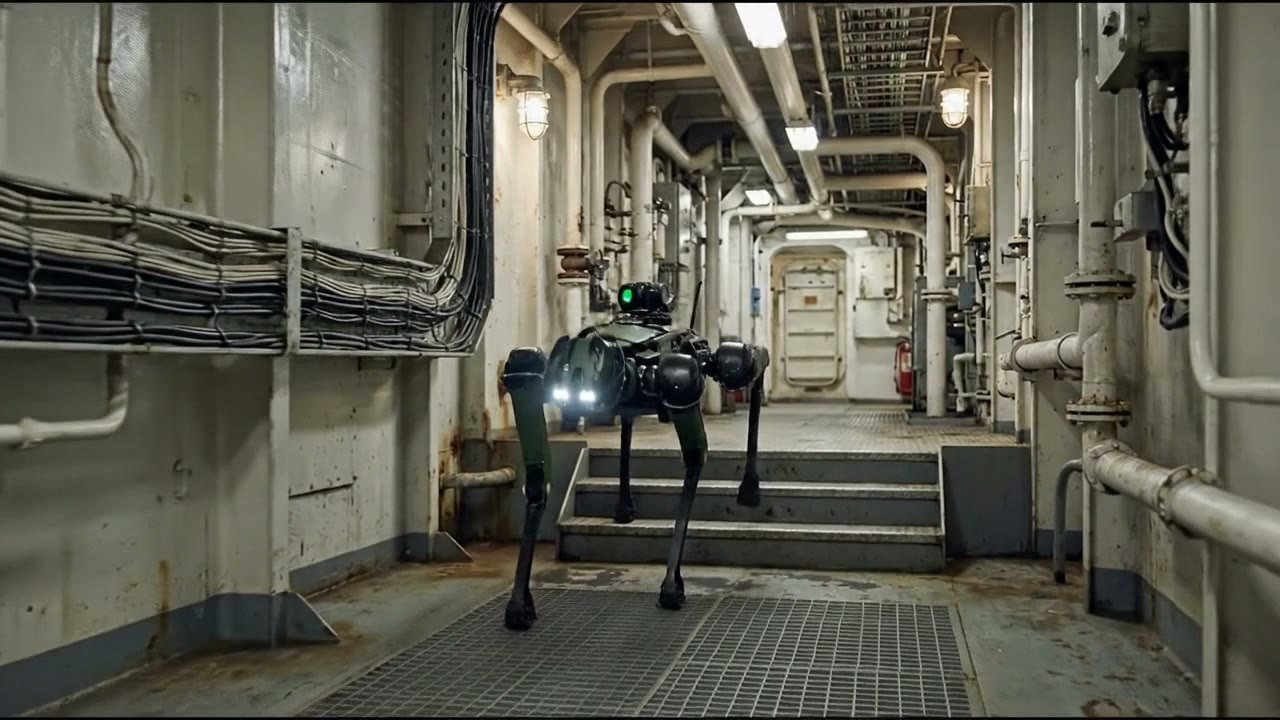
Quadruped robots
Quadruped robots for UK businesses
Four-legged robots — robot dogs — are the most field-proven category in robotics: rated for weather, happy on stairs and broken ground, and already doing real inspection and monitoring work. Forge Robotics helps UK organisations demonstrate, trial and adopt the right quadruped platform on a manufacturer-agnostic basis.
Systems we connect into: control room and VMS, WMS, maintenance and helpdesk, and the incident log. How our integration software is designed to work
What they are
Built for the ground your site actually has
A quadruped robot carries sensors and payloads across terrain wheeled platforms cannot handle — stairs, kerbs, gravel and wet ground — which is why inspection and monitoring lead every serious industrial use of the category.
The practical anatomy matters more than the novelty: perception sensors and obstacle avoidance at the front, a 360° LiDAR and payload rail on the back for inspection equipment, an IP-rated body with swappable batteries, and articulated legs that keep the payload level over broken ground. Everything else — routes, autonomy, alerts — is configuration against your task.
Use cases
What UK businesses use quadruped robots for
The strongest early cases are observational: looking, recording and reporting — consistently, on repeat, in places you would rather not send a person.
Site & asset inspection
Repeatable photo, video and thermal records of the same assets from the same positions — changes stand out.
Monitoring & patrols
Out-of-hours rounds of depots, compounds and facilities under remote supervision.
Hazard-area reconnaissance
Eyes on confined, elevated or live-traffic areas without putting a person in them.
Mapping & surveying payloads
LiDAR scanning and mapping runs over ground vehicles and people cannot cover easily.
Research & development
ROS 2-friendly platforms with open SDKs for locomotion, SLAM and perception work.
Demonstrations & engagement
The most field-proven robot category — a credible first robot for most organisations.
Related: robot security patrol · humanoid robots · industrial inspection drones · highways & infrastructure · manufacturing & industrial · quadruped inspection guide · robot subscription & hire options · consumer vs industrial quadrupeds compared, with video
Tell us the task and the ground. The integration review says whether a quadruped fits and what it would report into.
Request an integration reviewPlatforms
9 quadruped platforms, one independent view
From compact evaluation platforms through wheeled-legged hybrids to heavy-duty, IP67-rated extreme-environment patrol machines — matched to your task and site, not to a single brand.
Not locked to any single vendor: we demonstrate humanoid and quadruped platforms from multiple manufacturers, and recommend on best fit for your task.
FR-Q1 · Compact inspection quadruped
Agile, low-cost quadruped — the everyday inspection and demo dog.
View datasheetFR-Q2 · Heavy-duty industrial quadruped
Industrial heavy-duty quadruped — load, endurance and IP67 toughness.
View datasheetFR-Q3 · Mid-size industrial quadruped
Medium industrial quadruped — lighter than the heavy-duty class, with hot-swap endurance.
View datasheetPlus 6 more in the full robot range.
How adoption works
From first look to a defensible decision
No leaps of faith: prove one route or one asset first, then widen from evidence.
Not sure which platform class fits? The integration review settles it, before any demonstration.
Request an integration reviewFrequently asked questions
What is a quadruped robot (robot dog)?
A four-legged mobile robot — often called a robot dog — designed to carry sensors and payloads across terrain wheeled robots cannot handle: stairs, kerbs, gravel, wet or broken ground. Most industrial quadrupeds carry cameras, LiDAR or thermal payloads and are used for inspection, monitoring and survey work.
How much does a quadruped robot cost in the UK?
Entry-level platforms suitable for research and evaluation start at a few thousand pounds; industrial-grade, IP-rated platforms with inspection payloads run considerably higher and are priced per configuration. Pricing is confirmed per enquiry — and hire, loan or evaluation arrangements can make a first trial far cheaper than ownership.
Can robot dogs work outdoors in UK weather?
Industrial quadrupeds are rated for rain, dust and wide temperature ranges, and handle stairs and uneven ground. Weather limits — wind, standing water, visibility — are agreed as operating boundaries in any pilot plan, exactly as they would be for a human crew.
Do quadruped robots need a driver?
They can be tele-operated, follow pre-programmed routes autonomously, or mix both — a supervisor sets a route and intervenes only on alerts. First pilots usually start supervised and reduce oversight as the platform proves itself on your site.
How do we trial a quadruped robot?
The realistic sequence is a demonstration against your actual task, then a focused supervised pilot — one route or asset, agreed success measures, a few weeks of operation — before any wider decision. Forge Robotics arranges both on a manufacturer-agnostic basis.
Get started
Start with an integration review
Tell us the task (an inspection round, a patrol, a survey) and the systems your team runs. We come back with a written view of what fits and how it would connect, then arrange a demonstration against the task if the fit is real.