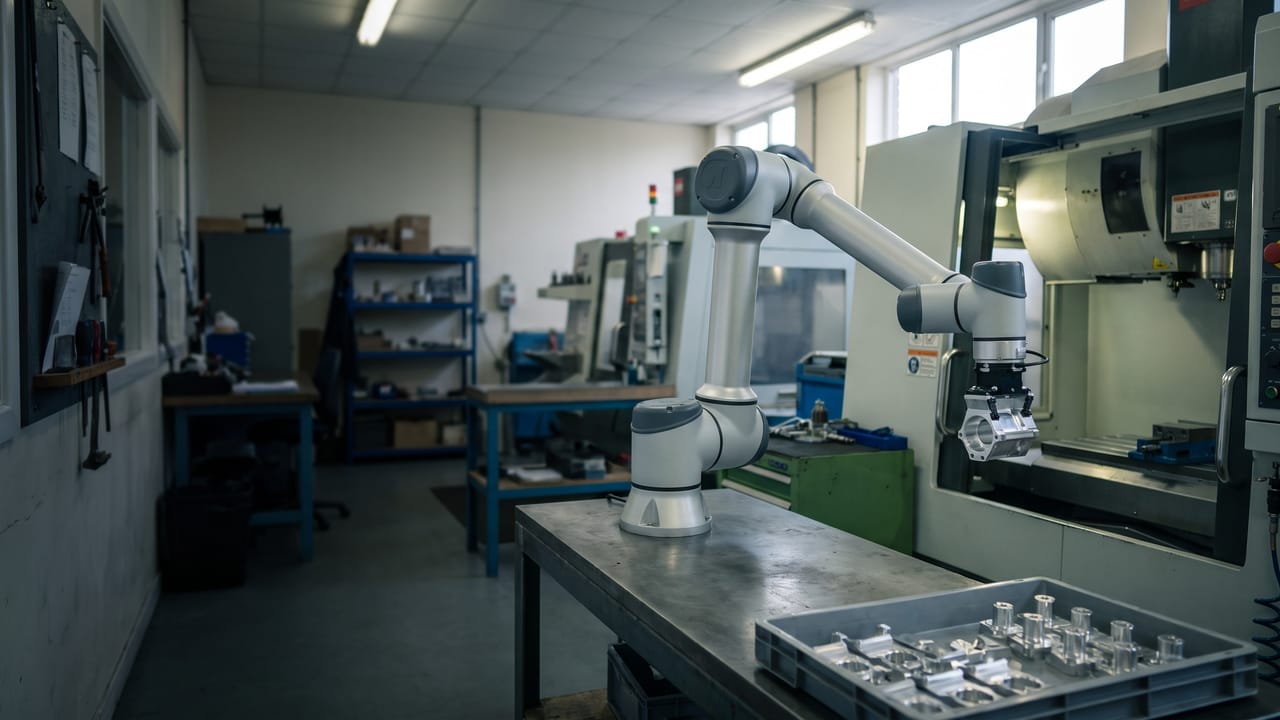
Collaborative robots
Cobots in the UK: collaborative robots matched to the task
Cobots are robot arms designed to work alongside people, without the large fenced cells of a traditional industrial robot. For UK manufacturers they are often the first step into automation: machine tending, cobot welding, palletising and packing. Forge Robotics helps you choose the right cobot for the task, not the brand, and plan how it fits your line and your systems.
Forge Anvil is being developed to connect robot cells to a site’s own systems; connections are scoped site by site. How our integration software is designed to work
By Forge Robotics · Last updated:
The basics
What is a cobot?
A cobot, or collaborative robot, is an industrial robot arm designed to share a workspace with people. It senses unexpected contact, limits its speed and force when someone is close, and can usually be taught by hand. Most are six- or seven-axis arms that move between jobs far more easily than a fenced industrial robot.
The trade-off is speed and strength. A cobot usually moves more slowly than a traditional industrial robot and carries less: most models handle a payload (the weight the arm can carry, including its tool) from roughly 3 kg to 30 kg, with a few going higher. For small batches, frequent changeovers and steady-paced work, that is often the right balance.

| Cobot | Traditional industrial robot | |
|---|---|---|
| Working near people | Designed for shared space once the application is risk assessed | Usually behind fixed guarding or a fenced cell |
| Speed and payload | Slower; most carry roughly 3 kg to 30 kg | Faster; payloads range much higher |
| Programming | Often taught by hand or with a tablet interface | Usually programmed by a specialist |
| Footprint | Small; can sit on a table or a mobile stand | Larger cell, including the guarding |
| Best fit | Small batches, frequent changeovers, steady pace | High volume, short cycle times, heavy parts |
Use cases
Where does a cobot fit in UK manufacturing?
A cobot in manufacturing earns its place on work that is repetitive, steady in pace and done in small or medium batches. Machine tending, welding, palletising, packing, inspection and assembly are the common jobs. Cobots are often used to cover a shift that is hard to staff, or to take a heavy, repetitive lift away from people.
Machine tending
Loading and unloading CNC machines, presses and moulding machines, often across a second shift.
Welding
MIG and TIG seams on small and medium batches, with the welder teaching the path by hand.
Palletising
End-of-line stacking of cases and sacks, where lifting is repetitive and the pace is steady.
Pick and place, packing
Moving parts between trays, conveyors and fixtures, or placing products into cartons.
Inspection and test
Presenting a part to a camera or gauge in the same position every time.
Screwdriving, gluing, finishing
Assembly steps that need consistent torque, bead or pressure along a taught path.
Cobot automation tends to suit firms that make many different parts in modest volumes: subcontract machining, fabrication, food and drink packing, and component assembly. Where volumes are very high or cycle times very short, a traditional robot cell can still be the better answer. Sector detail sits on our manufacturing and industrial and automotive and engineering pages.
Cobot welding
Cobot welding: how does it work?
Cobot welding fits a MIG or TIG welding torch to a cobot arm. A skilled welder guides the torch along the joint by hand, records the path once, and the cobot repeats the seam while they prepare the next part. It suits batch fabrication and repeat jobs too varied for a dedicated robot welding line.
Because the path is taught by the person who knows the weld, a new job can be set up without a specialist programmer.
A cobot does not remove welding hazards. Arc light, fume, spatter and hot parts still need screens, extraction and PPE, so a cobot welding cell is risk assessed in the same way as any welding station, and often has a screen or table layout that keeps people out of the arc zone while it runs.

End of line
Cobot palletiser or robot palletiser: which do you need?
A cobot palletiser picks cases off the end of a line and builds the pallet pattern, taking a heavy, repetitive lift away from people. It suits modest line speeds and case weights within the arm’s payload. Faster lines, heavier sacks or tall stacks usually point to a traditional robot palletiser in a fenced cell instead.
There are two common layouts. A fenced cell puts the cobot palletiser behind guarding with interlocked access, much like a traditional robot palletiser. An area-scanner setup uses safety laser scanners on the floor: the robot slows as a person approaches and stops if they come too close, so a full pallet can be swapped while the other side keeps running.
Either way, the layout and safety functions come out of the risk assessment, not the robot’s data sheet.

Safety
Are cobots safe? ISO 10218 and ISO/TS 15066
No cobot is safe on its own. Safety depends on the whole application: the arm, the tool, the part, the speed and the people around it. In the UK that means a risk assessment of the specific cell, built on ISO 10218 and ISO/TS 15066 and on UK machinery and work-equipment law.
A risk assessment is a structured look at what could cause harm in the cell and what controls reduce it; the HSE explains the approach. Machinery supplied for use must meet the Supply of Machinery (Safety) Regulations 2008, and employers must make sure work equipment is suitable and safe to use under the Provision and Use of Work Equipment Regulations 1998 (PUWER).
The main standards are ISO 10218-1 (the robot) and ISO 10218-2 (the robot application and cell), both revised in 2025. The revision speaks of collaborative applications rather than collaborative robots, and much of the collaborative guidance now sits in ISO 10218-2. ISO/TS 15066 (2016) is still published and widely cited, especially for its body-region force and pressure limits. Collaborative operation is built from four approaches:
Safety-rated monitored stop
The robot stops and holds position while a person is in the shared space, then resumes when they leave.
Hand guiding
An operator moves the arm directly using a hand-guiding device, for teaching or positioning.
Speed and separation monitoring
Sensors track how close a person is; the robot slows, then stops, as the gap closes.
Power and force limiting
Contact is possible, so the robot, tool and task are designed to keep forces below set limits.
This is a summary, not legal or safety advice. Check the current editions of the standards, and agree which ones your risk assessment works to with the integrator who builds the cell.
Platforms
How do you choose between cobot manufacturers?
There are many cobot companies, and the arms look alike. The differences that matter show up in the task: payload at the reach you need, the programming software, the tooling ecosystem for grippers, welding and vision, and who supports the cell in the UK. Test two or three platforms against the same task brief.
Well-known cobot manufacturers include the following, listed alphabetically, not ranked. Each offers several models across different payloads and reaches.
- ABBGoFa and SWIFTI
- Doosan Roboticsseveral cobot series
- FANUCCRX range
- KUKALBR iisy
- Techman RobotTM series, with a built-in camera
- Universal RobotsUR e-Series and newer UR models
Compare payload at the reach you need, not the headline figure; repeatability (how closely the arm returns to the same point); how easily your team can change jobs; end-of-arm tooling (the gripper, torch or tool fitted to the wrist); safety functions; and the service and spares available after installation.
Cobot manufacturers looking for a UK route to market can read how we work with manufacturers. If seeing an arm on a real task would help the decision, read how demonstrations are arranged.
How we work
How does Forge approach a cobot automation project?
Forge Robotics is manufacturer-agnostic. We start from your task and site, then match the cobot, the tooling and the integration partner to it, and plan how the cell connects to the systems you already run. Forge can also supply the robot where that suits you. The first step is always an integration review.
- 01
Start with the task
Part, weight, cycle time, batch size, shift pattern and who works nearby. Not the robot.
- 02
Shortlist platforms
Two or three arms from different manufacturers that meet reach, payload and tooling needs.
- 03
Plan the cell and safety case
Layout, guarding or scanners, and the risk assessment, with the integration partner who will build it.
- 04
Connect it to the site
How the cell talks to the line, the machines and the systems that schedule and record the work.
The last step is where many projects stall. A cobot cell that cannot report what it made, or take work from the schedule, stays an island. Forge Anvil is being developed to bridge robot software such as ROS 2 and a site’s own systems (for example WMS, MES, BMS, VMS or alarm platforms) through APIs where possible. It is designed to keep the cell part of the line rather than a separate machine. Which connections are possible depends on the systems a site runs, so they are scoped site by site in the integration review. Read how Forge Anvil is designed to work.
Tell us the task, the part and the systems on site, and we will scope the cobot options with you.
Request an integration reviewCobots: frequently asked questions
What is the difference between a cobot and an industrial robot?
A cobot is an industrial robot arm designed so people can work near it, usually with built-in force and torque sensing, rounded links and lower speeds when someone is close. A traditional industrial robot is usually faster and stronger and works behind fixed guarding. The 2025 revision of ISO 10218 treats “collaborative” as a property of the application, not the robot alone.
Are cobots safe to work next to people?
Only when the whole application has been risk assessed. A cobot arm is designed for collaborative use, but a sharp part, a welding torch or a heavy box can make the same arm hazardous. UK duties under the Supply of Machinery (Safety) Regulations 2008 and PUWER 1998 apply, and ISO 10218 and ISO/TS 15066 guide how the safety case is built.
What can a cobot be used for in a UK factory?
The common jobs are machine tending, welding, palletising, pick and place, packing, inspection, screwdriving and gluing. Cobots suit work that is repetitive, steady in pace and done in small or medium batches, where a fast changeover and a small footprint matter more than top speed. They are often used to cover a shift that is hard to staff.
Can a cobot be used for welding?
Yes. Cobot welding is one of the most established uses: a welding torch is fitted to the arm, the welder teaches the path by moving the arm by hand, and the cobot repeats the seam. Welding fume, arc light and spatter still need controls such as screens and extraction, so the cell is risk assessed like any other welding station.
Can a cobot palletise boxes?
Yes, within its payload and reach. Cobot palletisers handle cases at the end of a line and suit modest speeds and pallet heights. Some are fenced; others use area scanners that slow or stop the robot when a person comes close, so pallets can be changed without stopping the line. Heavier loads or faster lines may need a traditional robot palletiser.
Which cobot manufacturers are there?
Well-known cobot manufacturers include Universal Robots, FANUC (CRX), ABB (GoFa and SWIFTI), KUKA (LBR iisy), Doosan Robotics and Techman Robot, among others. They differ in payload, reach, software, tooling ecosystem and UK support. The right choice depends on the task, the tooling you need and who will support the cell after installation.
How does Forge help choose a cobot?
We start from the task and the site, not a brand. Forge Robotics shortlists suitable arms from different manufacturers, works with integration partners on the cell and safety case, and plans how the cell connects to your existing systems. The first step is an integration review, where your systems and constraints are scoped.
Next step
Planning a cobot cell?
Start with an integration review. We look at the task, the part, the people who work nearby and the systems you already run, then shortlist cobot options from different manufacturers and the partners to build and support the cell in the UK.