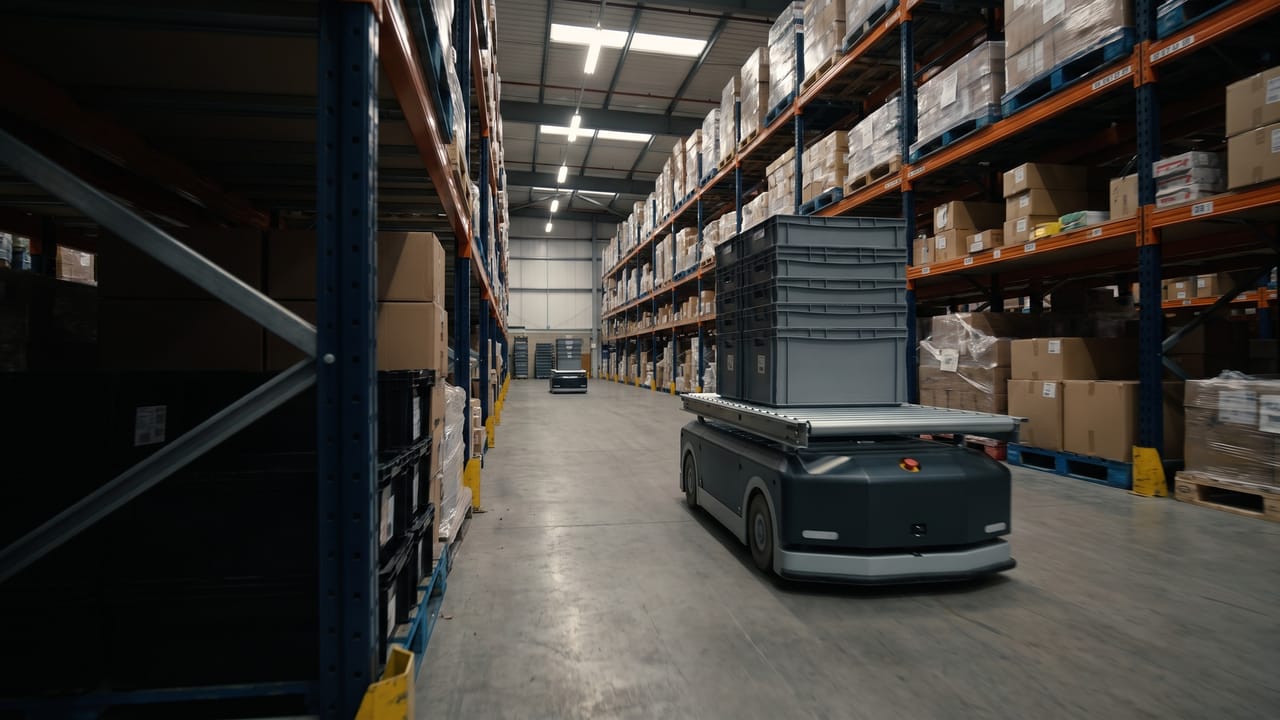
Autonomous mobile robots
Autonomous mobile robots (AMRs) for UK sites
Autonomous mobile robots (AMRs) are wheeled robots that map a site, plan their own routes and steer around people and obstacles while they move goods. UK warehouses and factories use AMR robots for picking support, replenishment and line feeding. Forge Robotics matches the right AMR to your task across manufacturers, supplies it where that fits, and plans how the fleet connects to your systems.
Forge Anvil is being developed to connect robot fleets to a site’s own systems; connections are scoped site by site. How our integration software is designed to work
By Forge Robotics · Last updated:
The basics
What is an autonomous mobile robot?
An autonomous mobile robot, or AMR, is a wheeled mobile robot that moves materials around a site without fixed guidance. It builds a map of the building, works out where it is, plans its own route and slows or steers around people and obstacles. Routes are changed in software rather than on the floor.
The technique behind it is SLAM (simultaneous localisation and mapping): the robot uses LiDAR, which measures distance with laser light, and often cameras to map the site and track its own position against walls, racking and other fixed features. Safety scanners watch the space around it, and fleet manager software assigns jobs, plans traffic and sends robots to charge.
An AMR is one kind of driverless industrial truck. The others are AGVs, autonomous forklifts and mobile manipulators, which are AMRs carrying a robot arm.
AMR vs AGV
AMR vs AGV: what’s the difference?
An AGV (automated guided vehicle) follows fixed guidance such as magnetic tape, wires or reflectors and usually stops when blocked. An AMR builds its own map, plans its own route and steers around obstacles. AGVs suit fixed, repetitive runs; AMRs suit routes that change and spaces shared with people. Many modern AGVs now blur the line.
An AGV robot is often the right answer for a heavy load on the same path all day, where predictability matters more than flexibility. Changing its route means changing the guidance or the programme. An AMR trades some of that predictability for flexibility.
| AMR (autonomous mobile robot) | AGV (automated guided vehicle) | |
|---|---|---|
| Navigation | Builds its own map with LiDAR and cameras and plans its own route | Follows fixed guidance: magnetic tape, wires, reflectors, floor markers or fixed virtual paths |
| Flexibility | Re-routed in software when the layout or the job changes | Route changes mean new infrastructure or reprogramming |
| Infrastructure | Little or none on the floor; needs a map, Wi-Fi and chargers | Guidance installed and maintained along every route |
| Obstacle handling | Slows, then plans a way around an obstacle where there is room | Typically stops and waits until the path is clear |
| Typical use | Changing routes, mixed traffic, picking support, line feeding | Fixed, repetitive runs and heavy loads on set paths |
The line is blurring: many modern AGVs use natural navigation without tape or reflectors, and many AMRs can be told to keep to fixed lanes. Compare the specific vehicles, not the label.
Robot types
What types of AMR robots are there?
The main types of AMR robots are shelf movers for goods-to-person picking, tuggers that tow carts, pallet movers and autonomous forklifts, collaborative picking carts that travel with pickers, and top-module AMRs that carry conveyors or lifts. The load, the route and how goods are handed over decide which type fits the job.

Shelf movers (goods-to-person)
Drive under a mobile shelf, lift it and bring it to a picking station, so the picker stays put.
Tuggers and towing AMRs
Pull a train of carts along a route, often for line feeding or moving parts between areas.
Pallet movers and autonomous forklifts
Move full pallets between racking, docks and production; heavier, with their own safety demands.
Collaborative picking carts
Travel with or ahead of pickers through the aisles, carrying totes so people walk less.
Top-module and conveyor AMRs
Carry a roller deck, lift or other top module to load and unload at fixed stations.
Warehouses
How are AMRs used in a warehouse?
In a warehouse, AMRs cut the walking in picking and internal transport. They bring shelves or totes to pickers, travel with pickers through the aisles, replenish pick faces from reserve stock and carry finished orders to packing and dispatch. People keep the handling and judgement; the robots carry the miles between them.
AMR warehouse projects usually start with one flow, such as moving totes from picking to packing, measured against today’s walking time or deliveries per hour. Our warehouse and logistics page covers the wider set of warehouse jobs, and our guide to trailer and container unloading robots covers the dock.

Manufacturing
How are AMRs used in manufacturing?
In manufacturing, AMRs move parts and work in progress so that operators and forklifts do not have to. Common jobs are line feeding from stores to the line, moving work in progress between processes, delivering kits to assembly stations and taking finished goods or empty containers away. Tuggers and top-module AMRs are typical here.
Kitting means gathering the parts for one job or assembly into a single tote or cart. AMRs often deliver those kits to the line, where the robot moving the parts may sit alongside an industrial robot fixed in a cell. More on the sector is on our manufacturing and industrial page.
Before a pilot
What does your site need before an AMR pilot?
Before an AMR pilot, a site needs floors the robots can cross, reliable Wi-Fi on every route, an agreed map, a plan for sharing aisles with people and forklifts, a way through doors and lifts, space for chargers, a risk assessment against ISO 3691-4, and a clear view of the systems the fleet must talk to.
- Floors: level, clean and in good repair, with thresholds, ramps and drains the robot can cross.
- Wi-Fi: reliable coverage on every route and at every station, tested where the robot will actually run.
- A map and routes: the areas, aisles, stations and no-go zones the robots will use, agreed with the people who work there.
- Traffic management: how robots, people and forklifts share aisles, crossings and junctions.
- Doors and lifts: fire doors, fast-acting doors and lifts the robot must pass, and how it triggers them safely.
- Charging: where chargers go, how long robots charge and how that fits the shifts.
- Safety: a site risk assessment, with ISO 3691-4 as the standard for driverless industrial trucks.
- Systems: which WMS or MES the fleet must take tasks from and report back to.
ISO 3691-4 sets safety requirements for driverless industrial trucks and their systems, and names AGVs and AMRs among them. A mobile manipulator also brings in the robot-arm standards, such as ISO 10218-2. UK duties under the Supply of Machinery (Safety) Regulations 2008 and PUWER 1998 apply, the HSE’s workplace transport guidance covers routes shared with people and vehicles, and every site needs its own risk assessment.
This is a summary, not legal or safety advice. Check the current editions of the standards and guidance, and agree the safety case with the people who will run the site.
Systems
Can AMR fleets connect to your WMS and MES?
Often, yes. AMR fleets usually connect through their fleet manager software, which takes tasks from a WMS (warehouse management system) or MES (manufacturing execution system) and reports back when a move is done. What is possible depends on the systems and versions a site runs, so each connection is scoped site by site.
VDA 5050 is an open industry interface for exchanging orders and status between a central master control and AGVs, published by the German Association of the Automotive Industry (VDA). Forge Anvil is being developed to bridge robot software such as ROS 2 and a site’s own systems (for example WMS or MES) through APIs where possible. It is designed to keep the fleet part of the operation, and connections are scoped site by site in the integration review. Read how Forge Anvil is designed to work.

Platforms
How do you choose between AMR robot companies?
Choose between AMR robot companies on the job, not the brochure: the robot types and payloads they offer, how their fleet software handles traffic and mixed fleets, the integration options for your WMS or MES, the safety case they support, and the service and spares available in the UK. Pilot two or three against one route.
Well-known autonomous mobile robot companies include the following, listed alphabetically, not ranked:
- Geek+goods-to-person, picking and sorting robots
- Locus Roboticscollaborative picking robots
- MiR (Mobile Industrial Robots)AMRs with top modules and pallet movers
- Omronmobile robots for factories and logistics
- OTTO (Rockwell Automation)AMRs for material handling
Forge Robotics works across manufacturers: we start from the task and the site, shortlist the platforms that fit, and can supply the robots where that suits you. If seeing a robot on your route would help, read how demonstrations are arranged.
Tell us the route, the loads and the systems on site, and we will scope the AMR options with you.
Request an integration reviewAutonomous mobile robots: frequently asked questions
What is the difference between an AMR and an AGV?
An AGV, or automated guided vehicle, follows fixed guidance such as magnetic tape, wires or reflectors and usually stops when something blocks its path. An AMR, or autonomous mobile robot, builds its own map, plans its own route and steers around obstacles. AMRs are re-routed in software. The line is blurring, as many modern AGVs also navigate without fixed guidance.
What is an AMR robot used for?
AMR robots move materials around warehouses and factories: bringing shelves or totes to pickers, travelling with pickers, replenishing stock, moving goods to dispatch, feeding parts to production lines, moving work in progress between processes and delivering kits to assembly stations. They suit repeated internal transport where routes change, people share the space and walking time is the cost to cut.
Do AMRs need magnetic tape or reflectors?
Usually not. AMRs navigate with a map they build of the site using LiDAR and cameras, and they localise against walls, racking and other fixed features. They do need a reliable map, Wi-Fi coverage, chargers and sometimes markers at docking stations. Traditional AGVs are the ones that rely on tape, wires or reflectors, although many newer AGVs navigate naturally too.
Can AMRs work safely around people and forklifts?
They are designed to, but safety comes from the whole site, not the robot alone. AMRs carry safety scanners that slow and stop them near people, and ISO 3691-4 sets requirements for driverless industrial trucks. A site risk assessment should cover traffic routes, crossings, forklift interaction, speeds, doors and lifts before robots share space with people.
Can an AMR connect to our WMS?
Often, yes, usually through the fleet manager software that assigns tasks to the robots. What is possible depends on the WMS, its version and the AMR platform. Forge Anvil is being developed to help bridge robot software and site systems such as a WMS or MES through APIs where possible. Connections are scoped site by site in an integration review.
Which AMR companies operate in the UK?
Several autonomous mobile robot companies sell into the UK, including MiR (Mobile Industrial Robots), OTTO (part of Rockwell Automation), Locus Robotics, Geek+ and Omron, among others, directly or through partners. They differ in robot types, payloads, fleet software, integration options and UK support. The right choice depends on the task, the site and the systems the fleet must connect to.
How do we start with autonomous mobile robots?
Start with one internal transport job: a route, a volume and a measure such as walking time saved or deliveries per hour. Check the site: floors, Wi-Fi, traffic, doors and the systems involved. Then shortlist two or three AMR platforms, run a demonstration or pilot on that route, and plan the integration before scaling. An integration review is the first step.
Next step
Planning an AMR pilot?
Start with an integration review. We look at the route, the loads, the people and vehicles around them and the systems you already run, then match AMR options across manufacturers and plan how the fleet connects to your WMS or MES.