By Simon Bumford, Founder & CEO, Forge Robotics · Last updated: 2026-10-25
What is an industrial cleaning robot?
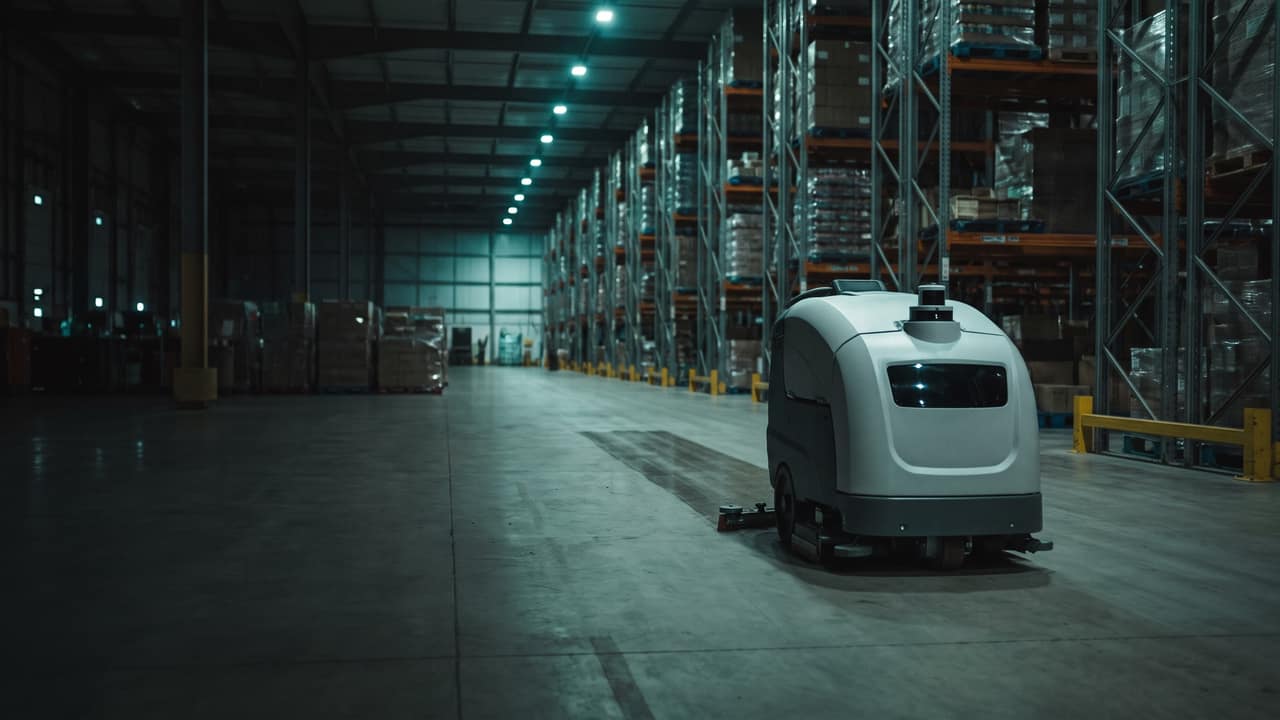
An industrial cleaning robot is an autonomous floor-cleaning machine for large non-domestic spaces. It scrubs, sweeps or vacuums hard floors along a route it has mapped, avoids people and obstacles with its sensors, and returns to a dock to charge. A person sets it up, supervises it and handles what it cannot reach.
Most are robotic versions of familiar commercial machines. A scrubber-dryer puts down water and detergent, scrubs the floor with brushes or pads, then lifts the dirty water with a rear squeegee and vacuum, so the floor is left close to dry. Sweepers collect dust and debris from warehouse and factory floors, and robotic vacuums handle carpeted offices. An AMR (autonomous mobile robot) navigates with its own sensors and maps rather than fixed tracks; a cleaning robot is an AMR whose job is the floor.

How do commercial cleaning robots differ from domestic robot vacuums?
A commercial cleaning robot is built for large non-domestic floors, long daily runs and commercial cleaning tasks such as scrubbing and drying, and it is set up and supervised by a site team. A domestic robot vacuum is a small appliance for household rooms. They share an idea, not a design: size, duty, safety approach and support all differ.
In practice the differences show in tank and battery size, the floor area covered per charge, how routes are mapped and edited, how the robot behaves around people in a working building, and how it is serviced. Commercial floor machines also have their own electrical safety standard: IEC 60335-2-72 covers powered ride-on and walk-behind floor treatment machines for commercial use, such as sweeping and scrubbing machines in hotels, schools, hospitals, factories and shops. Ask any supplier, in writing, which safety standards its autonomous machine has been tested against.
This page is not about hull or ship cleaning robots, which work on a vessel’s hull and are a separate marine specialism.
Where do commercial floor cleaning robots fit on a UK site?
Commercial floor cleaning robots fit large, open, repetitive hard floors cleaned on a schedule: warehouse aisles, factory walkways, school and hospital corridors, airport and station back-of-house areas, and retail stockrooms. They fit less well in cluttered rooms, on stairs, in small offices and anywhere the layout of the floor changes from hour to hour.
| Environment | Typical floor | Typical robot task | What to check |
|---|---|---|---|
| Warehouse and distribution | Sealed concrete, wide aisles | Sweeping and scrubbing main aisles overnight | Pallets left in aisles, racking, forklift traffic |
| Factory and production | Concrete or resin, marked walkways | Scrubbing walkways and open floor between shifts | Oil and swarf, machine guarding, segregated zones |
| Hospital and healthcare | Vinyl or safety flooring, long corridors | Scrubbing corridors and circulation areas | Infection-control procedures, patient areas, lifts |
| School, college and university | Vinyl, tiles, sports-hall floors | Scrubbing corridors and halls out of hours | Term-time access, furniture, doors |
| Airport and station back-of-house | Tiles, terrazzo, concrete | Cleaning service corridors and staff areas | Security zones, access control |
| Retail back-of-house | Vinyl or concrete | Stockrooms and loading areas | Deliveries, cages and trolleys left out |
Public and passenger-facing areas raise extra questions about people, signage and supervision; starting in staff or back-of-house areas keeps a first pilot simpler.
For depots and facilities more widely, including checks such as cleaning verification, see transport, mobility and facilities. On warehouse floors a cleaning robot often shares aisles with other mobile robots; our warehouse and logistics page covers that environment.
How do routes, docking and overnight cleaning work?
A cleaning robot is usually walked or driven around the site once to build a map, then given routes and zones to clean on a schedule. Overnight it runs those routes on its own, avoids obstacles, returns to a dock to charge and, on some models, to empty and refill its tanks, and records what it covered.
Overnight cleaning suits robots because the floor is quiet. HSE’s guidance on cleaning and slips recommends cleaning during quiet hours when pedestrians are not around, and cleaning in sections so there is a dry path through an area; it also notes that while a floor is damp it will still be slippery. A robot schedule should follow the same principles: which areas, in what order, when people return, and who checks the floor before they do.
Someone still supervises. A robot stops at obstacles it cannot pass, such as a pallet left in an aisle or a closed fire door, and alerts an operator. Spills, edges, stairs, toilets and detailed work stay with the cleaning team.

What should you ask before a cleaning-robot pilot?
Before a cleaning-robot pilot, ask which floors and routes it will clean, what it does when something blocks the way, how it is supervised and serviced, what records it keeps, and which systems those records must reach. The answers decide whether the robot becomes part of the cleaning operation or stays a separate machine with its own screen.
- Floors and routes: which areas and floor types, and how much floor area per shift or per charge?
- Task: scrubbing, sweeping or vacuuming, and which chemicals, pads or brushes your floors need?
- Obstacles and people: what does the robot do at a blocked aisle, a closed door, a wet patch or a person in its way, and who is alerted?
- Supervision and training: who sets routes, empties and refills it, and responds to alerts? HSE’s PUWER overview says work equipment must be suitable for its intended use and used only by people who have received adequate information, instruction and training.
- Doors, lifts and access: does it need to pass doors, use lifts or enter access-controlled areas, and how would that be arranged?
- Records: what does it log (areas covered, times, photos, faults), and can you export that data in a documented format?
- Systems: which systems should know a route is done, such as a CAFM or helpdesk, and what do they accept?
- Service: who maintains it, how quickly, and what happens to the cleaning routine while it is out of action?
How we structure a pilot, with measures agreed before the robot arrives, is set out on our pilot programmes page, and how a robot can be seen working first is on robot demonstrations.
How do cleaning robots connect to CAFM and building systems?
Cleaning robots connect to CAFM and building systems through software in between. The robot or its fleet software records what it cleaned; an integration layer turns that record into an update the CAFM or helpdesk accepts, such as a completed job, and can pass faults or blocked routes on as tickets for the team to deal with.
CAFM (computer-aided facilities management) software is the system many estates and facilities teams use to schedule work, log jobs and record that they were done. A BMS (building management system) runs plant, doors and lifts. A first pilot needs neither connection: it can run standalone, with the robot’s own logs and photos reviewed by the team. Connecting the robot’s records to CAFM is worth scoping once the routine works, so the evidence of cleaning lands where the rest of the site’s work is recorded.
Whether a given robot offers an API (a defined way for other software to read its data or send it tasks) depends on the manufacturer and the model, so check before you choose.

How does Forge approach commercial cleaning robots?
Forge Robotics starts from the floors, the routes and the systems the robot’s records must reach, then matches a platform across manufacturers, arranges a demonstration or a scoped pilot, and plans how the robot fits the cleaning team’s routine. We can supply the robot where that fits the client.
Forge Anvil is being developed to bridge robot software such as ROS 2 and a site’s own systems (for example WMS, MES, BMS, VMS, CAFM or alarm platforms) through APIs where possible. It is designed to keep a cleaning robot’s records part of the site’s own reporting rather than another separate screen. Connections are scoped site by site in the integration review; read how Forge Anvil is designed to work. For robots that move goods rather than clean floors, see autonomous mobile robots.
Forge also supplies Yunji cleaning and delivery robots in the UK, including the UPC40 commercial cleaning robot. They are put forward where they fit the site, alongside other makers.
Frequently asked questions
What is an industrial cleaning robot?
An industrial cleaning robot is an autonomous machine that cleans large hard floors in non-domestic buildings such as warehouses, factories, hospitals and schools. It scrubs, sweeps or vacuums along a route it has mapped, avoids people and obstacles with its sensors, returns to a dock to charge and keeps a record of what it cleaned, while a person supervises it.
Are commercial cleaning robots the same as domestic robot vacuums?
No. A commercial cleaning robot is designed for large non-domestic floors, long daily runs and commercial cleaning tasks such as scrubbing and drying, and is set up and supervised by a site team. A domestic robot vacuum is a small household appliance. Size, duty, safety approach, servicing and support all differ, so they are not interchangeable.
Can a commercial floor cleaning robot work overnight?
Yes, and overnight is often when they work best, because floors are quiet. HSE guidance recommends cleaning during quiet hours and in sections, and notes that a damp floor is still slippery. The robot runs its routes, returns to its dock to charge and records what it covered; someone should still respond to alerts and check floors before people return.
Do cleaning robots replace cleaning staff?
No. They take on repetitive cleaning of large open floors, which frees cleaning staff for detailed work, spills, edges, stairs, toilets and the jobs a robot cannot reach. People still set routes, empty and refill the machine, respond when it is blocked and check the results. A robot changes the shape of the cleaning routine rather than removing the team.
How do cleaning robots connect to our CAFM or helpdesk?
Usually through an integration layer. The robot or its fleet software records what it cleaned; the integration layer turns that into an update your CAFM or helpdesk accepts, such as a completed job or a fault ticket. What is possible depends on the robot’s interfaces and on your system and its version, so it is scoped site by site.
Does Forge supply cleaning robots?
We can, where that fits the client. Forge Robotics is a manufacturer-neutral advisory, supply and integration business: we start from your floors, routes and systems, match a platform across manufacturers, arrange a demonstration or a scoped pilot, and can supply the robot. Forge Anvil is being developed to connect its records to systems such as CAFM.
Sources & references
Related: Yunji cleaning and delivery robots, supplied in the UK · transport, mobility and facilities · autonomous mobile robots · how Forge Anvil is designed to work · how a structured pilot programme works · how demonstrations are arranged
Forge Robotics is a manufacturer-neutral UK robotics advisory, supply and integration business operating under Raplin Ventures Ltd. HSE and IEC references are to their official public pages as read on 25 October 2026 and may change. What a particular cleaning robot can do, which standards it is tested against and which interfaces it offers vary by manufacturer and model, and are confirmed per project. This article is general guidance; no client relationship, live deployment or trading history is described. Forge Anvil is being developed. Forge supplies Yunji cleaning and delivery robots in the UK; other makers named here are compared on their published figures.